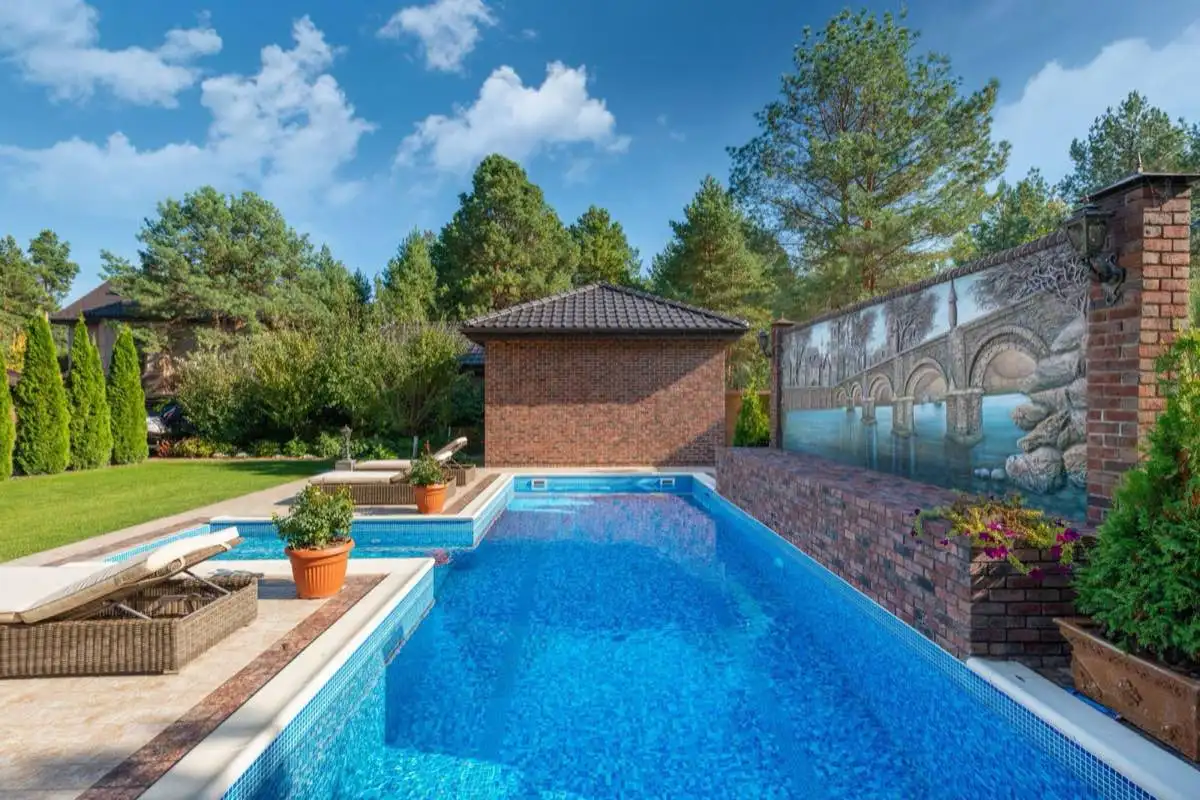
Short version: a saltwater pool is easier on your skin and cheaper to run, but costs more upfront and stings more when the salt cell dies. Chlorine is cheaper to install and dead simple to fix, but you become a part-time chemist who smells like a public pool. Neither one is "better" — they are better at different things.
Now the part nobody tells you at the pool store: a saltwater pool is a chlorine pool. It just makes its own chlorine instead of asking you to haul it home in a bucket. So this whole debate is less "salt vs chlorine" and more "do you want to manufacture your sanitizer or buy it by the jug." Which makes it a question about which chore you would rather own: a small machine, or a standing weekly errand. Here is how that plays out in a Elk Grove backyard.
The 30-second comparison
| Saltwater | Chlorine (traditional) | |
|---|---|---|
| Upfront cost | Higher (salt cell + board) | Lower |
| Yearly running cost | Lower (~$70–$100 salt) | Higher (~$300–$800 chemicals) |
| How the water feels | Soft, less harsh | Stronger "chlorine" feel |
| Maintenance style | Set it and check it | Hands-on, frequent |
| Big repair | Salt cell every 3–7 yrs | Rarely anything major |
| Equipment wear | Salt is tough on some metals | Gentler on hardware |
If you hate that table already, here is the one-liner: pay more now to do less later (saltwater), or pay less now and stay hands-on (chlorine).
Cost: where your money actually goes
Everyone asks which is "cheaper," which is like asking whether renting or buying is cheaper — depends how long you're staying.
- Saltwater costs more to set up because you're buying a salt chlorine generator (the cell) and a control board. Then it's cheap to run: salt is a few bags a year. The gotcha is the cell itself, a $200–$700 part that wears out every 3 to 7 years. Skip cleaning it and you'll be shopping for one sooner.
- Chlorine is cheap to install and there's no expensive part waiting to fail. You just pay steadily, all season, in tablets, shock, and the stabilizer that keeps Elk Grove's sun from burning your chlorine off by noon.
Over ten years the two usually land in the same ballpark. You're really choosing when you want to spend the money, not how much.
Upkeep: chemist vs. babysitter
A chlorine pool wants attention. You test, you add tablets, you shock it after a pool party, and if you go on vacation during a CA heat wave you may come home to something with its own ecosystem.
A saltwater pool wants consistency. The generator trickles in chlorine around the clock, so levels stay flat instead of spiking and crashing. You still test the water, still balance pH, and still clean the salt cell a few times a year — anyone who told you saltwater is "maintenance-free" was selling you the generator. It's less work, not no work.
The honest test: if checking your pool feels like a chore you'll skip, saltwater's steadiness will save you from yourself. If you actually enjoy fussing with it on a Saturday, chlorine gives you the control.
How the water feels (the reason most people switch)
This is the one that wins arguments. Saltwater keeps chlorine low and even, so you skip the red eyes, the itchy skin, and the swimsuits that fade three shades by August. The water feels silkier — that's the salt, at about a teaspoon per gallon, nowhere near ocean-salty.
Chlorine done right feels fine too. The trouble is chlorine done right means staying on top of it, and by mid-Elk Grove-summer a lot of pools are running hot on chlorine because the owner over-corrected after a green scare. Saltwater just makes it harder to get there.
So which one for a Elk Grove pool?
Most comparisons end in a shrug at this point. Ours does not — find the line below that describes you:
- Choose saltwater if you want low-effort, gentle water and you plan to keep the pool for years. In the Sacramento Valley's long swim season, the lower chlorine feel is genuinely nicer, and the running-cost savings add up over a long season.
- Choose chlorine if you want the cheapest install, you're comfortable being hands-on, or you're not sure how long you'll own the place.
- Skip both decisions if you just want it handled — that's what we're for.
One local note: Elk Grove's hard water and heat are rough on equipment either way, and salt is a little rougher. Good stainless hardware and a heater rated for salt matter here. That's exactly the kind of thing that separates a pool that lasts 20 years from one that nickel-and-dimes you — and it's why we spec equipment for the climate, not the catalog.
What converting actually involves
If you already have a chlorine pool and you're curious, the conversion is smaller than people expect. A salt chlorine generator gets plumbed into the return line after the filter and heater, the control board mounts on the equipment pad, and a licensed electrician ties it into a dedicated circuit. Then you dissolve in the salt, and this is where people underbuy: 3,000 ppm in 20,000 gallons is about 500 pounds, so budget eleven to fifteen 40-pound bags to land in the 2,700 to 3,500 ppm most systems want.
Most conversions are a one-day job in the $1,200 to $2,500 range installed, depending on the cell size and how cooperative your existing plumbing is.
Two things to sort out before you commit. If your pool was replastered in the last 30 days, wait — new plaster needs to cure before salt goes in. And if you have a heater with a copper heat exchanger, older mild-steel ladder anchors, or natural stone coping that has never been sealed, budget for those, because salt finds every weak metal on the property eventually.
Three myths worth killing
- "Saltwater is maintenance-free." It isn't. You still test, still balance pH, and still clean the cell two or three times a year. It's less work, not no work.
- "You can't shock a saltwater pool." You can and sometimes you should. Most systems have a boost or superchlorinate mode, and after a party or a storm a bag of regular shock is completely fine.
- "Salt ruins pools." Salt at 3,000 ppm is roughly a tenth of seawater. It's rough on unsealed stone and cheap metal, and utterly indifferent to properly specified equipment.
The bottom line
Saltwater vs chlorine isn't good vs bad. It's pay-more-now-do-less-later vs pay-less-now-stay-involved. Pick the trade-off that fits how you actually live, not the one the internet yelled loudest about.
If you'd rather not referee your own pool chemistry, Elk Grove Pool Builders installs and services both across Elk Grove and the Sacramento Valley — including saltwater systems and conversions, weekly service that keeps either type honest, and weekly service for the day the cell finally quits. Free quote, no pressure: call (833) 350-8721.
Ready for a free quote in Elk Grove?
Elk Grove Pool Builders — free estimate, clear scope, no pressure. Use the form on this page or jump to the homepage quote.
Related services in Elk Grove
Elk Grove Pool Builders money pages — go straight to the service you need.
- Pool Automation & Smart Controls →
Elk Grove Pool Builders installs pool automation tuned for Central Valley heat, foggy shoulder seasons, and Title 20 pump rules. Summer demands long filter cycles and spa spill management while winter brings cool nights and occasional freeze concerns on exposed plumbing.
- Saltwater Chlorination Systems →
Saltwater pool conversion in Elk Grove costs roughly $70 to $100 a year in salt and ends the routine of hauling chlorine jugs home from the store. A saltwater pool is still a chlorine pool, which surprises people, but the cell generates chlorine on site from water sitting at about 3,200 parts per million salt, roughly a tenth the salinity of seawater and about the level where you stop noticing it.
- Weekly Pool Cleaning & Maintenance →
Weekly pool service in Elk Grove runs $120 to $260 a month depending on pool size, tree load, and whether filter cleaning and salt cell service are included. A proper visit is not a lap around the pool with a net: we test and balance, brush walls and the waterline, empty skimmer and pump baskets, check filter pressure against its clean baseline, inspect the equipment pad, and flag anything trending the wrong way.
- Gunite & Shotcrete Pool Construction →
Gunite pool construction in Elk Grove builds a steel-reinforced concrete shell in whatever shape your lot allows, engineered for the expansive clay soils and hot valley summers this area is known for. We run the entire job in house under C-53 licensing: 3D design, City of Elk Grove permits, excavation, rebar, shotcrete, tile, coping, decking, equipment, and plaster startup.
- Pool Remodeling & Renovation →
Pool remodeling in Elk Grove typically costs a quarter to half of a new build, because the shell in the ground is almost always structurally sound and the expensive engineering is already done. What has aged out is the plaster, the tile, the coping, a cracked deck courtesy of clay soil, and equipment that predates every efficiency standard California has passed since.
Frequently asked questions
Is a saltwater pool cheaper than chlorine?
Day to day, yes. A saltwater pool in Elk Grove usually costs $70 to $100 a year in salt versus a few hundred in chlorine. The catch is the salt cell, which runs $200 to $700 and needs replacing every 3 to 7 years. So it is cheaper to run and more expensive to fix.
Do saltwater pools still have chlorine in them?
Yes. A saltwater pool makes its own chlorine by running salt through a cell. There is no chlorine jug, but the sanitizer doing the work is still chlorine — just gentler and steadier than what you pour from a bucket.
Can I convert my chlorine pool to saltwater?
Almost always. Converting an existing Elk Grove pool means adding a salt cell and control board and dissolving in bags of salt — usually a one-day job. Elk Grove Pool Builders does conversions regularly; call (833) 350-8721 for a quote.
Are saltwater pools better for your skin?
Most people think so. The chlorine level stays lower and more consistent, so you get less of the red-eyes, itchy-skin, bleached-swimsuit routine. It is not actual seawater — a salt pool sits at roughly a tenth of ocean salinity, which works out to about two teaspoons of salt per gallon of water.
How much salt does a saltwater pool need?
Most residential salt systems want 2,700 to 3,500 ppm. Taking a 20,000 gallon pool from plain water to that range needs roughly 450 to 580 pounds of salt — eleven to fifteen 40-pound bags — and fewer if the water already carries salt left behind by years of chlorine tablets. After that you only add salt to replace what splashes out or leaves with backwash water, because salt does not evaporate.
How do I know when the salt cell is failing?
Chlorine output drops even though the salt reading is fine, and the control board starts throwing low-output or check-cell warnings. Before you buy a new one, pull the cell and inspect the plates: scale buildup looks like white crust and cleans off with a diluted acid soak, and that fixes the problem more often than a new cell does.
Local context
How this applies in Elk Grove, CA
Every article here is written from pool work done in Elk Grove and the Sacramento Valley, so the numbers reflect local labour, permit and material costs rather than a national average. Your own job can land either side of them depending on access, the condition of what is already there, and the materials you pick — gunite and shotcrete shells, C-53 licensed pool construction, pebble, mini-pebble and quartz interior finishes.
The way to turn any of this into a real answer is to have someone look at your actual situation. The free estimate is free, itemized and written down, with no deposit and no obligation. Call (833) 350-8721 or start on the Elk Grove Pool Builders homepage.
Areas Elk Grove Pool Builders covers
Elk Grove first, then the surrounding communities of the Sacramento Valley. Each has its own page with local detail rather than a copy of this one:
- Sacramento, CA — Sacramento County, population 525,000
- Roseville, CA — Placer County, population 148,000
- Arden-Arcade, CA — Sacramento County, population 93,000
- Citrus Heights, CA — Sacramento County, population 87,000
- Folsom, CA — Sacramento County, population 81,000
- Carmichael, CA — Sacramento County, population 79,000
Or jump to the full list of Elk Grove services.
More from the Elk Grove Pool Builders blog
- How to Maintain a Saltwater Pool (Elk Grove Guide)
How to maintain a saltwater pool in Elk Grove, CA: salt and stabilizer to your cell maker's spec, pH 7.2-7.8, clean the cell every 3 months.
- How Much Does an Inground Pool Cost? Elk Grove
An inground pool in Elk Grove, CA runs about $45,000 to $75,000 for gunite. Here's the real cost by size and type, and what actually moves the price.
- Fiberglass Pool vs Gunite for Elk Grove Yards
Fiberglass vs gunite pools compared on cost, install time, upkeep, and lifespan — plus which fits a Elk Grove, CA backyard.
The Elk Grove Pool Builders Team
pool specialists serving Elk Grove, CA
Written by the Elk Grove Pool Builders team — insured pool pros with 15+ years serving Elk Grove, CA and the surrounding area.